
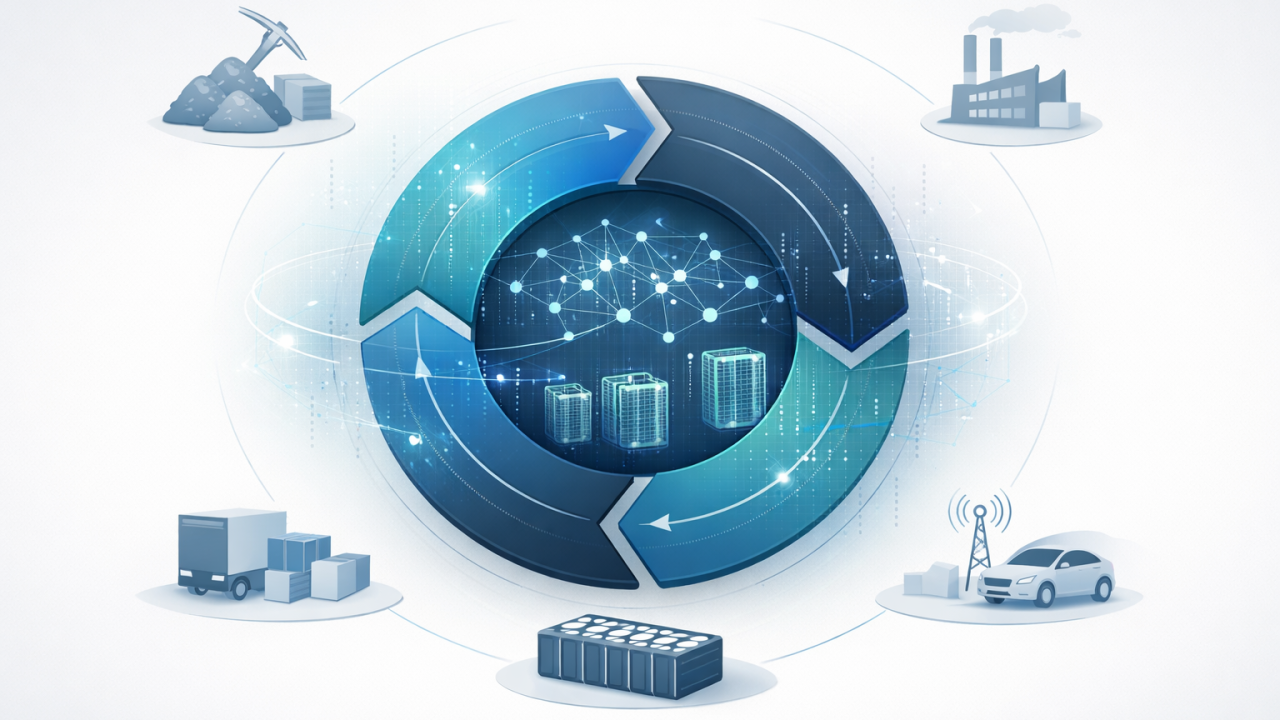
Closing the loop across materials, manufacturing, performance, and supply chains
For most of its modern history, the battery industry has moved forward in a fairly predictable, linear sequence. New materials are developed. Cells are designed around them. Factories are built. Products are shipped. Problems are discovered later, usually in the field, and lessons are fed back slowly, if they are fed back at all.
Learning happens, but it is inefficient. Each stage optimizes locally, and the distance between cause and effect is often too large for insight to travel quickly. By the time a failure mode is well understood, the decisions that contributed to it may be buried several development cycles in the past.
AI changes this dynamic, not by automating electrochemistry or replacing process engineers, but by connecting what has historically been disconnected. When data from across the battery lifecycle is captured, aligned, and revisited continuously, learning speeds up. More importantly, it starts to compound. Each generation of product and process becomes a clearer input into the next. This feedback-driven system is what I refer to as the AI battery flywheel.
This article steps back from individual tools and use cases discussed earlier in the series and looks at the system as a whole: how closing the loop across materials, manufacturing, deployment, and supply chains enables faster iteration, more reliable scale-up, and a fundamentally different basis for competition.
From Linear Development to Compounding Learning
Battery development has always depended on data, but for a long time that data was limited, expensive, and siloed. Lab measurements lived in notebooks or isolated databases. Manufacturing data was collected to keep lines running and yields acceptable, not to inform upstream design choices. Field performance data arrived late, aggregated, and often disconnected from the teams that could act on it.
That landscape has changed.
Today, even modest battery programs generate large volumes of detailed data across the lifecycle. Materials are characterized more thoroughly at the lab and pilot scale. Manufacturing and formation produce dense time-series data. Deployed systems generate continuous telemetry. Failures and degradation are logged with far more context than in the past.
At the same time, AI tools have matured to the point where they can work with messy, incomplete, and heterogeneous datasets while still respecting physical constraints. Models no longer need perfectly curated inputs to be useful, and they do not need to be retrained from scratch every time new data appears.
The result is a convergence that has not existed before. Batteries are becoming both data-rich and practically modelable. That combination is what makes a true learning flywheel possible, rather than a collection of disconnected optimizations that never quite add up.
What the AI Battery Flywheel Actually Is
The AI battery flywheel is not a single model, software platform, or dashboard. It is an operating mindset built around closing the loop across the entire battery lifecycle.
In practice, it means treating materials data, manufacturing and formation data, field performance, degradation behavior, and usage context as parts of a single system. Insights generated downstream are not treated as postmortems. They are fed back upstream into materials selection, cell design, process windows, and qualification strategies.
Each pass through this loop reduces uncertainty. Predictions improve. Decision timelines shrink. Teams gain confidence to intervene earlier, when changes are cheaper and more impactful. Crucially, no single dataset carries much value on its own. The value appears when data from different stages is connected and interpreted together.
Physics-informed machine learning, evolving digital twins, and continuous model updating are what allow this to work without turning the system into a black box. The goal is not blind optimization, but faster and more informed judgment.
Closing the Loop Across Design, Manufacturing, and the Field
One of the persistent challenges in battery development has been translating field behavior into upstream action. By the time a degradation trend becomes obvious in deployed systems, the material choices or process decisions that contributed to it are often several generations removed.
AI helps narrow that gap by making attribution more practical, even when it cannot be perfectly precise.
By correlating pack-level performance and failure data with manufacturing records, formation signatures, and material attributes, models can highlight which variables are most strongly associated with long-term outcomes. This makes it possible to connect real-world failures to specific process windows or material characteristics, distinguish intrinsic chemistry limits from manufacturing-induced variability, and redesign accelerated tests so they better reflect actual duty cycles.
The same logic applies inside the factory. Instead of treating manufacturing as a one-way gate that freezes learning after qualification, a flywheel-driven approach treats it as an adaptive system. Continuous analysis of production and formation data allows teams to detect drift earlier, uncover interactions between steps that are difficult to isolate experimentally, and transfer learning across lines, sites, and product generations.
Rather than relearning the same lessons with each new factory or chemistry, knowledge accumulates. Over time, manufacturing stops being a recurring reset and becomes a durable source of advantage.
When Supply Chains and Logistics Become Part of the Model
Supply chains have traditionally been managed around cost, availability, and risk. The electrochemical consequences of upstream variability were often invisible, surfacing only after products had been in the field for months or years.
In a closed-loop system, that variability becomes part of the technical model.
AI can link precursor properties, impurity profiles, or morphology differences to downstream performance and degradation trends. This enables more predictive sourcing decisions, faster root-cause analysis when issues emerge, and a gradual shift away from rigid pass–fail specifications toward tolerances informed by actual performance risk.
Battery material traceability supports this shift, but traceability by itself does not create value. The real leverage comes from predictive traceability: understanding not just where materials came from, but how specific material signatures influence lifetime, reliability, and failure probability.
Logistics and deployment conditions extend the same idea further. Batteries experience shipping delays, temperature excursions, storage dwell time, and a wide range of early-life usage profiles before they ever settle into steady operation. These factors matter, but they are rarely incorporated into design assumptions. AI makes them visible and quantifiable, allowing models to account for non-ideal handling, adjust lifetime and warranty expectations, and inform upstream packaging and deployment decisions.
Why the Flywheel Is Ultimately an Organizational Choice
Building the AI battery flywheel is less about tools than it is about behavior.
The biggest obstacles are rarely technical. They are organizational: fragmented data ownership across suppliers, manufacturers, and OEMs; incentives that favor short-term yield or cost over long-term learning; and understandable resistance to model-driven insights that expose uncomfortable variability.
The flywheel only spins when organizations are willing to confront what the data shows and act on it. AI does not create accountability, but it makes the lack of it increasingly difficult to ignore.
When closed-loop learning becomes the norm, the industry starts to look different. Chemistry iteration accelerates without sacrificing reliability. Factories improve cumulatively rather than episodically. Supply chains are optimized for performance stability, not just lowest cost. Battery products evolve through data and software as much as through hardware redesigns.
The advantage will not belong to those who collect the most data. It will belong to those who close the loop faster, more consistently, and with greater honesty about what the data reveals.
The battery industry has spent decades mastering individual steps in the value chain. The next phase will be defined by how well those steps learn from one another. The AI battery flywheel is how that learning compounds.
By: Dr. Nicholas Grundish