
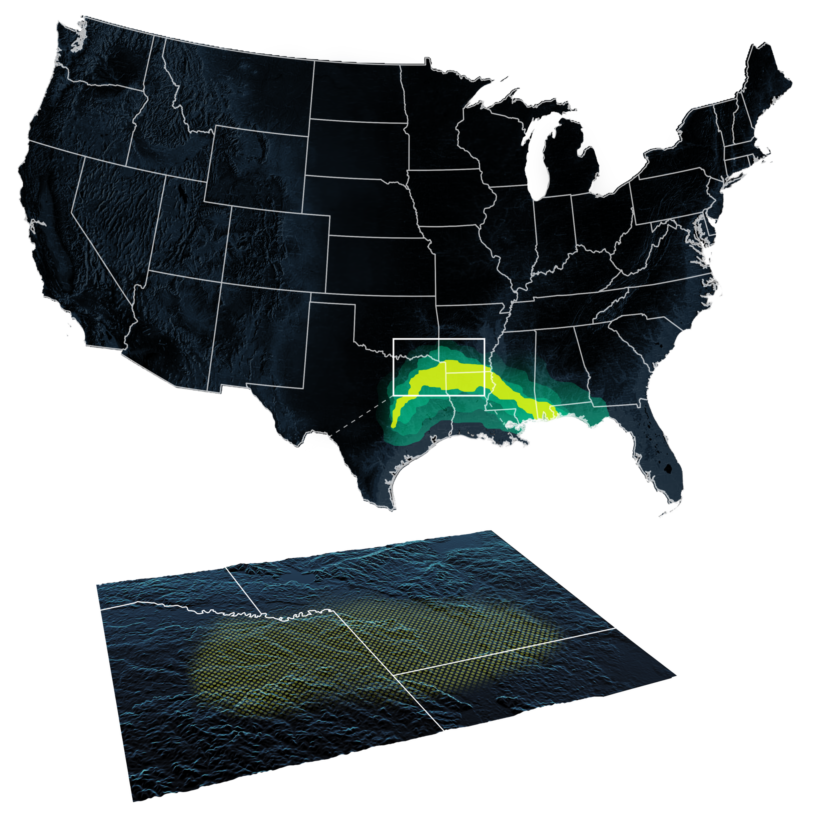
The Smackover Formation is a geological unit of the Jurassic age. It extends across the Gulf Coast region of the United States. It spans portions of Texas, Arkansas, Louisiana, Alabama, Mississippi, and Florida.
The Smackover formed approximately 150 million years ago as a carbonate reef and shallow marine system. It is characterized by its porous limestone structure. That structure makes it highly suitable for holding fluids: oil, gas, and, critically, lithium-rich brines.
The formation has been studied and produced for oil and bromine for decades. Its lithium potential was only recently quantified systematically.
Companies working in the Smackover had long noted unusual mineral concentrations in the brines co-produced with oil and gas. But the scale of the lithium resource was not calculated until recently. Geologists applied machine-learning analysis to existing brine chemistry data across the formation.
How Lithium Gets Into Brine: The Geology of the Smackover
Lithium in the Smackover Formation exists dissolved in subsurface brine. This is highly saline water held within the pore spaces and fractures of the formation’s rock matrix.
This brine accumulated over geological time as water circulated through lithium-bearing rocks. The water dissolved the lithium and became trapped as fluid within the formation.
The upper portion of the Smackover is known informally as the Reynolds oolite. It has higher porosity than the lower part and contains the most significant lithium concentrations.
The formation ranges in depth from approximately 2,000 feet (610 meters) at its northern extent in Arkansas. It reaches more than 22,000 feet (6,700 meters) further south.
The most commercially accessible lithium brines are concentrated in the shallower northern portions. These span southwestern Arkansas counties including Lafayette, Columbia, and Union.
The brine chemistry of the Smackover differs from the South American Lithium Triangle in one important respect. Smackover brines are co-produced with oil and gas operations. The drilling, pumping, and fluid handling infrastructure already exists across much of the formation footprint.
Lithium extraction from Smackover brines can leverage existing oilfield infrastructure. It does not require an entirely new development program from a greenfield starting point.
The Scale of Smackover Lithium Resources
In October 2024, the US Geological Survey published findings from a machine-learning study. The Arkansas Department of Energy and Environment collaborated on the study.
It found the Smackover Formation in southern Arkansas alone contains between 5.1 and 19 million metric tons of lithium in its brines.
The USGS noted the upper range of this estimate. It would meet projected 2030 world demand for lithium in car batteries approximately nine times over.
Smackover brine samples from southwestern Arkansas have reached up to 616 milligrams per liter in individual exploration wells. Wells in Lafayette County, one of the most prospective areas, averaged approximately 582 milligrams per liter.
These concentrations are commercially significant. They compare favorably with brine resources being developed in South America.
The USGS study focused on southern Arkansas. It does not capture the full extent of the Smackover across other states.
Development activity is also active in Texas and other Gulf Coast states. The total lithium resource across the complete formation is likely substantially larger than the Arkansas-specific estimate.
Why the Smackover Is Central to US Domestic Lithium Strategy
The United States currently imports the majority of its refined lithium. Building a domestic lithium supply chain has been designated a national security priority. Department of Energy programs include grant funding and loan guarantees to accelerate commercial lithium production from domestic resources.
The Smackover Formation is the most significant domestic lithium resource identified to date by the USGS. It sits in the southern United States, with existing oilfield infrastructure and proximity to Gulf Coast and Southeast manufacturing corridors. Established road and rail connectivity gives it practical development advantages over more remote or environmentally constrained domestic resources.
Political and regulatory conditions in the Smackover footprint also support development. Texas and Arkansas have established oil and gas regulatory frameworks. These frameworks can accommodate brine production and lithium extraction as an extension of existing oilfield operations.
This reduces permitting uncertainty compared to entirely new extraction technologies in new regulatory contexts.
How Direct Lithium Extraction Unlocks the Smackover’s Potential
Conventional brine lithium production uses solar evaporation ponds. These work well in high-altitude Andean environments with extreme solar irradiance and minimal rainfall. The Smackover Formation in Texas and Arkansas does not offer those conditions.
Evaporation-based production in the Gulf Coast climate would be slow, land-intensive, and economically marginal.
Direct lithium extraction is the technology that makes Smackover lithium commercially viable. DLE systems extract lithium from brine through active chemical or electrochemical processes rather than passive solar evaporation.
DLE systems operate on timescales of 1 to 2 days and function in any climate. They achieve recovery rates approaching 90% compared to the 30 to 40% typical of evaporation ponds. They can also be integrated with the fluid handling systems already in place at oilfield operations.
The Smackover combines resource scale, existing oilfield infrastructure, and DLE technology. This may be the strongest near-term domestic lithium development opportunity in the United States.
Some companies hold significant acreage in the most prospective portions of the formation. Those with DLE technology validated on Smackover brine sit at the intersection of resource endowment and operational capability.
EnergyX’s Project Lonestar™ and the Smackover Opportunity
EnergyX’s primary US lithium development program, Project Lonestar™, is centered on the Smackover Formation. The project covers approximately 47,500 acres (19,200 hectares) across Texas and Arkansas. This is one of the largest single-company acreage positions in the formation’s most commercially prospective portion.
EnergyX received a $5 million grant from the Department of Energy. The grant supports construction of a demonstration plant in East Texas. There the company is validating and scaling its GET-Lit™ direct lithium extraction platform on Smackover brine.
Phase 1 of Project Lonestar™ targets 12,500 tonnes per annum of battery-grade lithium production by 2028. Later phases scale to a full commercial target of 50,000 tonnes per annum.
Lithium samples produced from EnergyX’s Austin pilot plant have been qualified by cathode customers. This confirms that the production process delivers material meeting commercial battery manufacturing standards.
The project’s acreage position includes 330 acres of cleared land secured near the planned refinery site. The site has a dedicated rail line for product transport.
Why Investors and Energy Companies Are Paying Attention
The Smackover Formation has attracted attention from investors and energy sector participants for reasons that go beyond resource scale alone.
Geographic and policy positioning is the first factor. Lithium produced from US domestic brine in Texas and Arkansas qualifies for IRA critical minerals provisions. These provisions require increasing shares of battery materials to come from domestic or allied-nation suppliers.
Manufacturers seeking to maintain eligibility for EV and battery production tax credits have a structural incentive. That incentive is to source from domestic lithium projects.
Infrastructure leverage is the second factor. EnergyX can extract lithium from brine co-produced in existing oilfield operations, using established fluid handling systems. This reduces capital requirements and permitting timelines compared to developing a new resource from scratch in a remote location.
Community and economic impact is the third factor. Project Lonestar™ is projected to generate billions of dollars in regional economic impact. It is also projected to generate more than 3,000 direct, indirect, and construction jobs.
EnergyX is also investing about $20 million in its East Texas demonstration plant. These commitments support community relations and regulatory processes in the region.
EnergyX is conducting a securities offering under Regulation A of the Securities Act of 1933.
Investors and energy industry partners interested in EnergyX’s Smackover position can find offering details at invest.energyx.com.
Frequently Asked Questions
What is the Smackover Formation?
The Smackover Formation is a Jurassic-age geological unit. It extends across the Gulf Coast region of the United States, including Texas, Arkansas, Louisiana, Alabama, Mississippi, and Florida. Characterized by porous limestone, it holds oil, gas, and lithium-rich brines, and has produced oil and bromine for decades.
How much lithium is in the Smackover Formation?
The USGS estimated between 5.1 and 19 million metric tons of lithium in southern Arkansas Smackover brines alone. At the upper range, that would meet projected 2030 global demand for EV battery lithium approximately nine times over. The full formation including Texas and other states is likely larger.
Why is the Smackover significant for US energy independence?
The Smackover is the largest domestic lithium resource identified by the USGS to date. It sits within existing oilfield infrastructure in the southern United States, with established road, rail, and processing connectivity. This gives it practical development advantages, and developing it is central to reducing US dependence on imported lithium.
Why is direct lithium extraction necessary for the Smackover?
Conventional evaporation pond lithium production requires extreme solar radiation and low humidity. The Gulf Coast climate does not provide those conditions. DLE systems use active innovative processes to extract lithium from brine in 1 to 2 days, regardless of climate.
What is EnergyX’s Smackover position?
Project Lonestar™ covers approximately 47,500 acres of the Smackover Formation in Texas and Arkansas. EnergyX operates an East Texas demonstration plant, supported by a $5 million DOE grant, validating GET-Lit™ on Smackover brine. Phase 1 targets 12,500 tonnes per annum of battery-grade lithium production by 2028.
Are other companies working in the Smackover Formation?
Yes. The scale of the resource identified by the USGS has attracted some of the largest names in energy. ExxonMobil holds more than 300,000 net acres in the Arkansas Smackover and has already produced battery-grade lithium at pilot scale, while Chevron acquired roughly 125,000 acres across Northeast Texas and Southwest Arkansas in 2025. Both majors see the formation as the foundation of a domestic lithium supply chain as oil and gas companies expand into critical minerals.
EnergyX’s Project Lonestar™ sits in the same play, neighboring these positions, with approximately 47,500 acres and an active DOE-funded demonstration plant.
That combination of acreage, federal backing, and operating demonstration infrastructure makes it among the most advanced programs currently targeting the formation.
Sources
USGS Smackover Arkansas lithium estimate (5.1 to 19 million metric tons, nine times 2030 demand): US Geological Survey.
USGS Smackover resource fact sheet and brine concentration data: US Geological Survey.
EnergyX Project Lonestar acreage, DOE grant, and economic projections: EnergyX and Carbon Credits.
EnergyX securities offering: EnergyX investment portal.
This article is for informational purposes only and does not constitute investment advice. The EnergyX securities offering is made only by the official offering circular available at invest.energyx.com. Investing in early-stage companies involves significant risk including potential loss of the entire investment. Please read all risk disclosures carefully before investing.